
4.2 metres, crane-installed: our largest model to date
A 4.2-metre container ship model — steel-framed, sectioned for transport, and lifted into an upper floor by crane.
At 4.2 metres this is not a gift; it is an engineering piece. Most of the ship models we build live in an office, a showroom or a glass case. This one had to live in a building — carried up a floor by crane, bolted through a verified slab, and expected to stand for years as the centrepiece of the space.
An engineering brief, not a gift order
The brief began the way our engineering projects always do: with the constraints of the destination, not the model. Which floor? What is the slab load rating? Where are the rigging points, how wide is the doorway, is there a lift, and what does the fire code say about floor-standing exhibits? We ran a load check with the building’s management, surveyed the rigging path floor by floor, and only then confirmed the model’s section plan.
Internal steel framing carries the weight — the same principle as a real vessel’s structural skeleton, built to the same dimensional fidelity that ISO standards expect of the containers it stacks. Without the frame, a hull this size would rack and drift over its own lifespan; with it, the model reads rigid from every angle.
Built in sections, rebuilt on site
The hull is sectioned so each part fits a lift and a doorway — and so each section can be crated, transported and re-joined without visible seams. Every cut line was chosen to pass through a natural structural break, with alignment keys and a numbered assembly sequence, so the site crew re-joined the hull in the same order we welded it in the workshop. Sections also had to survive road transport to site without flexing — a specification that shaped the internal frame as much as the loads above ground did, and one that ordinary gift production never has to think about.
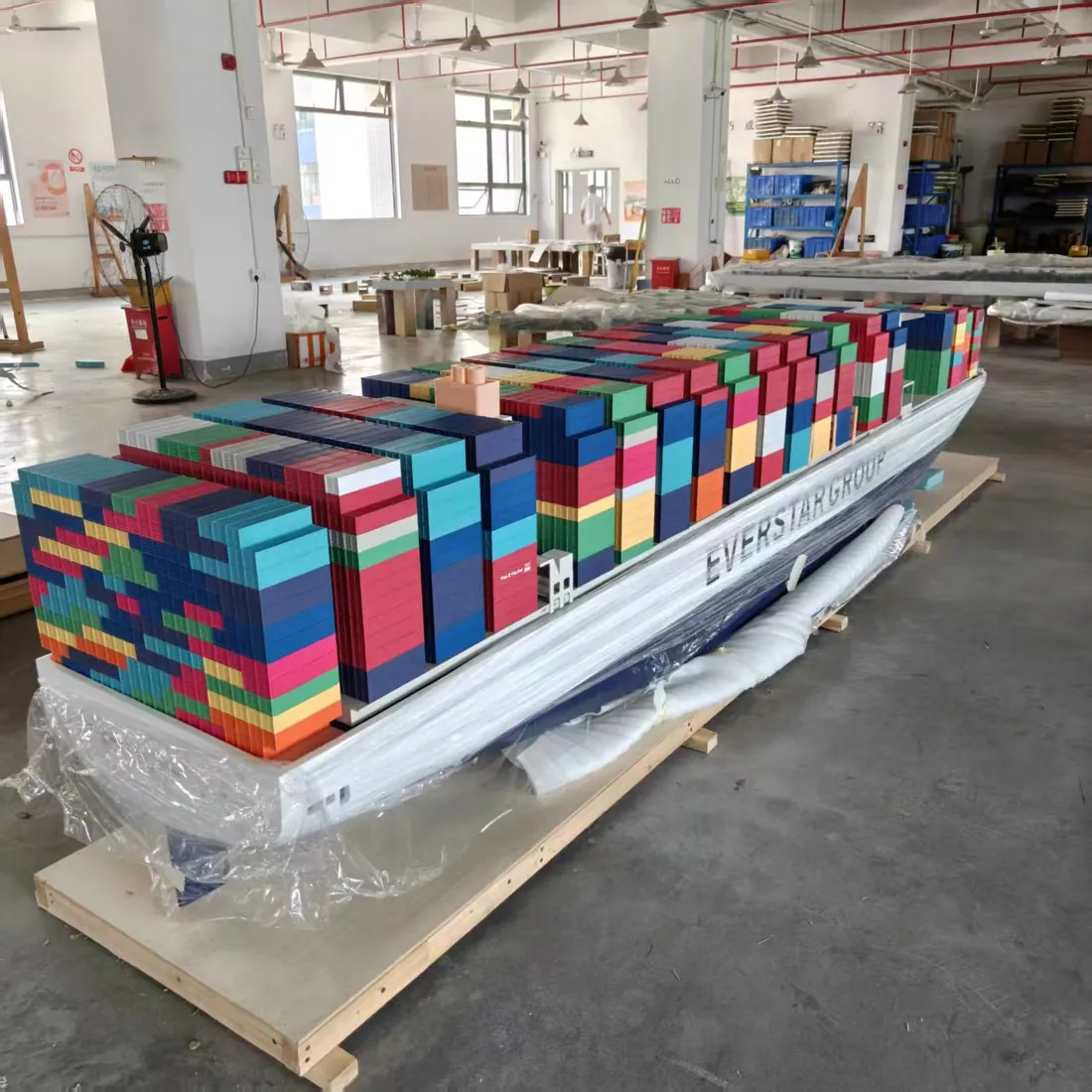
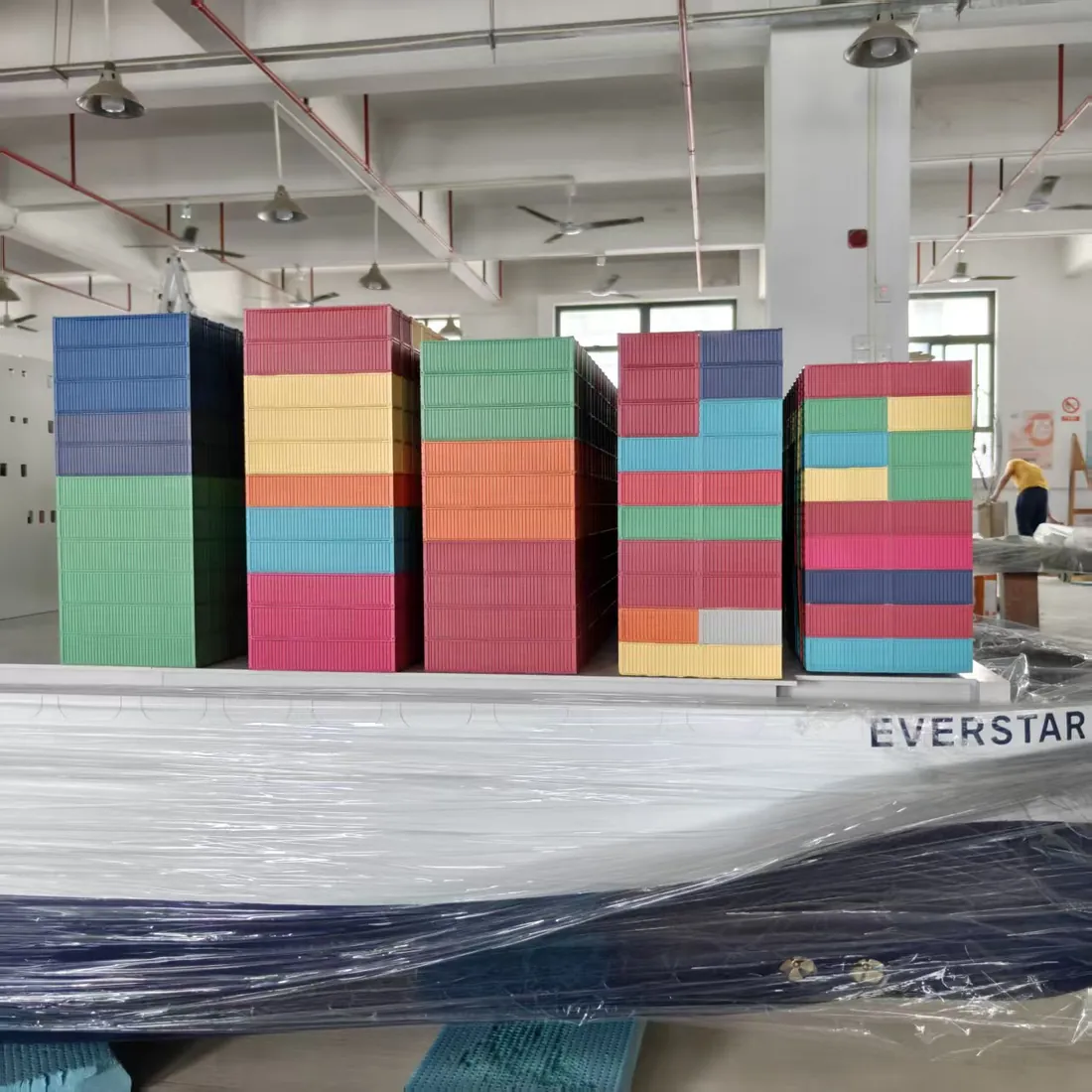
Each container stack is individually fitted and aligned — thousands of them. At this scale there is no forgiving distance: an office visitor can walk up to the hull and inspect the weld line, the railing, the print on a single container door. That is the inspection standard we built to.
Crane day
Installation was planned with the building: load checks on the receiving slab, certified rigging points, a path survey from truck to final position. The sections were lifted one floor up through a coordinated window — crane, signals, spotters, and a sequence rehearsed on paper before anything left the ground. Re-assembly on site followed the numbered sequence, with every joint checked against the workshop fit.
The lesson of crane day is that a large model is a construction project with a deadline. The model itself is half the work; the other half is making sure it arrives in pieces that fit the building, and that the building agrees.
The economics of one-off engineering are worth stating plainly. There is no unit price to multiply and no re-order to amortise the development: drawings, load checks, section planning and site supervision are all real hours attached to a single hull. What the client buys is certainty — a centrepiece that arrives on the planned day, passes the building’s own safety review, and stands without drama for the life of the space. That is a different product from a gift programme, produced by the same hands, to the same colour and detail standard — and, unlike a gift, one whose acceptance test is written by a building inspector as much as by a brand manager. The engineering discipline behind it is documented in how our models are built, and the material trade-offs at every size in the scale guide.
Where this sits in our range
This is the top of our range — from 6cm cruise miniatures to a 4.2-metre exhibition piece, a 70× span from one production system. The same workshop that hand-paints a pocket-sized vessel also welds the steel frame of a lobby centrepiece, which is what being a specialist supplier means: the scale is the client’s choice, the standard is ours.
Large-format work also changes the commercial shape of a programme. There is no unit price to multiply — there is a specification to engineer: drawings, load calculations, transport sections, installation supervision. Sampling follows the same route as every model we build (and the same fee-then-credit logic), but tooling becomes fabrication: jigs, frames and fixtures built for one hull. What does not change is the colour and detail standard — the same master that holds a fleet run’s livery across 7,000 units in the EVERGREEN programme holds this hull’s livery across four metres of steel and paint.
If you are planning a large-format installation, start with the surrounding stories: national-project deadlines in Adora Magic City in 3 months, landmark builds at 227 cm in the Viking programme, and how large models are specified in our ship model scale guide. The engineering context is in how our models are built, our registered designs are on the patents page, and our full range from 6cm upward is in container ship models and scale models. Ready to talk dimensions? Start the conversation.
The result
4.2 m, built in sections, crane-lifted one floor up and rebuilt on site — 70× our smallest 6 cm model.